


 Q&A Meet Linda Crabtree
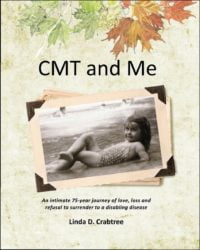
Q: In your recently published autobiography, CMT and Me: an intimate 75-year journey of love, loss and refusal to surrender to a disabling disease, you talk about not giving in to CMT. Can you share a story about how you kept going?
A: When I was just a little kid, I wanted to do what all the other kids did, and my mother didn’t stop me. I wore heavy metal braces as a child in the ‘40s, and slept in tendon stretchers that were hot and heavy, but I kept going. High school was horrendous because I kept falling down the stairs, but that didn’t stop me from getting a good education, although I never did finish. I went back to school when I was older and had some clout to change things so that, finally, school worked for and not against me. I often had no difficulty finding work; however, getting to work and into the workplace was my biggest challenge. Stairs have always been a huge barrier for me. I worked outside of the house for approximately 15 years in photographic production and in a variety of newspaper editorial positions and then ran CMT International for 18 years from our home office. And, at 76, am still working, but for myself. I think that was the key: to be my own boss because it allows me to set my own pace and work from home. I’ve never been accused of thinking small or being lazy but, because of my CMT, I do have to do things my own way, and sometimes that doesn’t fit with the way employers want things done. I’ve had very down periods in my life but have always found a way to turn things around so that I can use what I have left to make a difference.
Q: You were the pioneer in sharing information about living with CMT with people around the world from 1984 until 2002 — LONG before the internet and social media. How did that help you deal with your own CMT challenges?
A: I began looking for people with CMT back in 1984 because I couldn’t find any information on CMT at all—anywhere—and I needed to know more about this condition that was changing my life. The many letters I wrote to newspaper editors all over North America brought in hundreds of letters from people telling me about their CMT and all wanting advice. I didn’t have any advice to give them, so I designed the CMT Newsletter so we could all share what little each of us knew. Everyone helped everyone else and, eventually, we also included advice from doctors and professionals worldwide. We promoted research, gave out scholarships, and held conventions to bring people together. You can just imagine how my life changed when I had thousands of people with the same disease giving me a reason to move, to push, to work, to feel useful. I was working to find out about CMT, not just for myself, but for everyone else as well. I learned something new about CMT every day for 18 years, and most of that went into the CMT Newsletter. I had been a journalist and newspaper editor, so I knew how to put a newsletter together. You are right that it was long before the internet and social media, so mail was the only way to go and we used to it for 18 years to send out information to people all over the world. When we shut down CMT International in 2002, I put a great deal of that newsletter information on LindaCrabtree.com so it wouldn’t be lost. It is still there, and much of it is still relevant today.
Q: In your book there are some exceptionally intimate passages concerning sex and sexuality, self-esteem, marital problems, and finding love. What prompted you to include this information?
A: I knew from the beginning that if I was going to write this book at all, I was going to be honest and forthright about everything. Why bother if you’re going to cover up or exclude the things that changed your life? I believe that when any woman writes about her life, all women learn from it. What I’ve been through, millions of other women have been through as well, but it’s always good to know that you’re not alone. And, on top of everything, I was coping with the added stresses of CMT taking away my ability to walk and use my hands. Not
all women find their second spouse through the personal ads in the newspaper, have an opportunity to design their own home, are given an honorary doctorate, or are awarded the highest honour their country can give: the Order of Canada and I also have the Order of Ontario. We are entering a new age for women, and I may be 76, but I have believed all of my life that women should not be exploited but recognized as having sexual desires and needs just as men are. Women who profess to enjoy sex are often labeled as loose or sluts. Men who profess to enjoy sex and search it out are macho and virile. This double standard has been part of society forever. I’m hoping it will change now that women are speaking out.
Q: In your opinion, why has CMT not become as recognizable and researched as diseases like Multiple Sclerosis, ALS, or even Muscular Dystrophy?
 A: I think part of the reason is that CMT is something that slides up on you. Because it is genetic, you were born with it. Some of us, like me, begin to see the signs when we are very young. For me, it was at 16 months. Others slowly see degeneration over the years, while some only notice their CMT in later years. MS and ALS have been recognized for a long time. There are many types of Muscular Dystrophy, so I won’t get into that. In the past, the literature on CMT, what little there was of it, reported that it is simply a nuisance. Since there is no cure or treatment, physicians simply ignored it. Now that we know what causes it, a great deal of research is being done, and because it can be diagnosed through blood tests, doctors are taking note. Since 1984 there has been a great deal more literature pushed from the private sector to have CMT recognized as a condition with many secondary side-effects. These side-effects, such as vision and hearing problems, vocal cord and diaphragm paralysis, curvatures of the spine, hip dysplasia (there’s a long list of symptoms in my book) can puzzle a physician if s/he doesn’t recognize it as possibly (and I say possibly, because not everything should be chalked up to CMT) part of the CMT diagnosis, they can’t properly treat a person with CMT.
Because the disease has been ignored for so long, it has taken years to interest researchers and to raise money for that research. Although it is estimated that there are three million people with CMT worldwide, there might only be one family in any given region and, because people with CMT can be few and far between, it is difficult to interest the public in fundraising projects. It also seems that if a disease doesn’t kill or totally incapacitate you, it doesn’t get the respect or attention it deserves. Now that CMT is becoming more well-known and its ability to disable recognized, larger sums of money are being
directed towards research, and that’s what we need. In 1984, no one knew what caused CMT. Now we know and can go forward to learn to treat—and eventually—eradicate it.
Q: If you could give your younger, CMT self some advice, what would it be?
A: Back when I was a teenager, if I’d have known what CMT could do to me, I would have concentrated on getting an education in the sciences as either a psychologist, geneticist, or in one of the fields where I could use my brain 99% of the time and not have to stand, walk, or rely on my hands. As it was, I got my undergraduate degree in psychology but was unable to continue to get my masters/doctorate, simply because I was a mature student and didn’t have the energy that I had when I was in my 20s. I would also value myself more. I didn’t realize my potential back then. If you think smart about your future when you’re young, you have a huge advantage when you’re older. I think genetic and educational/career counseling is worth its weight in gold.
Q: You’re quite the traveler! What tips would you offer to someone living with CMT who is anxious about traveling with a disability?
A: I really haven’t traveled that much. I’ve been to the U.K. a couple of times and traveled across Canada and United States. I do run a website AccessibleNiagara.com for tourists with physical disabilities who want to visit the Niagara Falls, Ontario, Canada area, and have for the last 16 years. My advice is to do your homework before you go. Talk to other people who have CMT who have been where you are going. The way to do that is to get on the CMT Facebook pages. Some major cities and tourism venues have websites that tell you what is accessible, where to rent a scooter, wheelchair or other aids for daily living, and give you answers to basic questions before you leave home. Or, call ahead and ask if the venues you want to visit and the hotel you are thinking of using are accessible. The U.S. is pretty good, but other countries vary drastically.
Q: It is mentioned in your book that during the 18 years CMT International existed you worked with more than 10,000 people with CMT. Thank you for everything you’ve done for those with CMT you’ve touched over the years, Linda! How can people get your book?
A: CMT and Me is available on Amazon.com in 13 countries. The e-book is available for Kindle, Kobo, iBooks, Barnes & Noble and just about every other e-book distributor out there. The paperback is 328 pages (which includes a Resource section on CMT and symptoms often overlooked by the medical profession), plus 225 photos. The e-book has about one-third of the photos and identical text. Working with my CMT peers for the past 34 years has truly been a life-changing pleasure, and I am still online almost every afternoon at li***@***********ee.com.









Linda I really need your help. My daughter has CMT. She was diagnosed when she 37. I as her mother had noticed that she walked differently since she was a young teenager. She’s has seen a specialist in Mac. She has the CMT X . She has had braces for both of her ankles that goes up her legs. When she wears them it effects her back. They have put her on narcotics but that just takes the edge of so she can function a little. I’m asking you as her mother that doesn’t want her to end her life because she can’t get the help she needs to please advice me on what she can do to make her life easier.
I am 69 and have been struggling daily since I was a child. Now worried about hip replacement! Being diagnosed in my 40s and then finding you was a life saver. You are my heroine! Thank you for all your work researching, organizing, and communicating!
What information can you provide regarding hip replacement? I’ve been in excruciating pain for the past several years and now I very seldom walk. I can only tolerate the pain for trips to the bathroom and to get food from the kitchen. I’ve put off hip replacement because I fall and, therefore, feel like I’ll just continue re-injuring the hip after replacement. Also, my nerves have never fully recovered from previous other surgeries and also after any injuries from falls. I’m very interested in any advice/information you can offer me about hip replacement.
In so many ways it’s heartening to know that I’m not alone and that there are a surprising number of people who have been diagnosed with CMT. I began to develop symptoms in my 40’s; they have gradually progressed. I’m now 75 years old, prefer a walker to a cane and walk very slowly with bilateral leg braces. I have flaccid bilateral foot drop as well as weakness in lower legs and back. I don’t want to end up in a wheelchair, and walk and exercise as much as I can. My mother had many symptoms, my brother has mild symptoms, and my son is following my disease course.
I read your book and loved it. Thanks for sharing. I also have CMT, now 73 years old. Braces since 1991.
I am so impressed! I am a 72 year old women. I was diagnosed at 18 because it took me so long to walk from the bus tunnel to my office because it was always cold and difficult to walk. A boyfriend suggested I see what was going on. I gained a realization of why I fell, why was so clumsy as a child and so un-atheletic, but, other than that it did nothing for me to know. It took 8 years for me to trip over a blade of grass and finally get into AFOs. I was so excited to walk. The only shoes I could find were sandals, but I wore them proudly with a tee-shirt with running feet and “Feet don’t fail me now” on the front.
It has been a long learning and adjustment. At the time there was not much info, as Linda said. She is a hero to me when I read all she has pioneered for CMT. I am so pleased that she is as courageous and forward-thinking, and really glad to read someone from my generation.
You are such a motivator ,Thank You for that….
I’m 76 ,my Son 50 My Daughter 53 we all have CMT…
I have moved from One cane to two canes now a Walker.Myson was wearing AFO’s now full leg braces.My Daughter is still doing OK with her balance …We all have trouble with energy ……
When you said ,” now we know what causes CMT” what did you mean,All I know is they inherited CMT from me….l don’t know where it came from,.
My brother died from ALS…..is there’s connection ….
What the medication did you take for pain relief. I currently take Tramadol and Gabapentin. At times the pain is still unbearable.